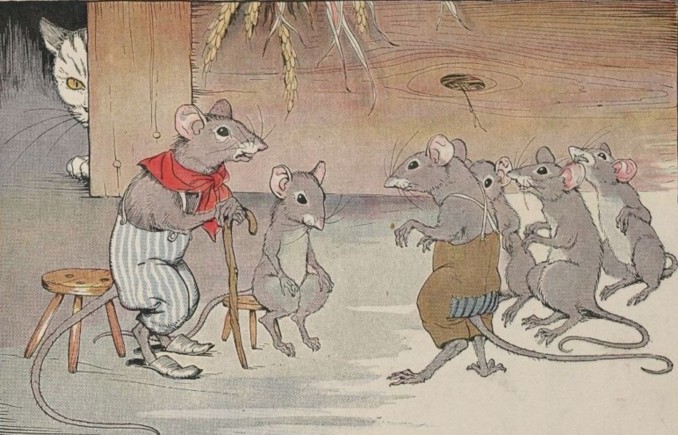
Belling the Cat

As Aesop didn’t actually say:

The Mice once called a meeting to decide on a plan to free themselves of their enemy, the Cat. At least they wished to find some way of knowing when she was coming, so they might have time to run away. Indeed, something had to be done, for they lived in such constant fear of her claws that they hardly dared stir from their dens by night or day. Many plans were discussed, but none of them was thought good enough. At last a very young Mouse got up and said: “I have a plan that seems very simple, but I know it will be successful. All we have to do is to hang a bell about the Cat’s neck. When we hear the bell ringing we will know immediately that our enemy is coming.” All the Mice were much surprised that they had not thought of such a plan before. But in the midst of the rejoicing over their good fortune, an old Mouse arose and said: “I will say that the plan of the young Mouse is very good. But let me ask one question: Who will bell the Cat?”

More heat than light seems to me to be generated by the demand for IDists to “define CSI” and the equations that are fired back in response. Nobody is disputing that we have plenty of equations.  Here is that bright young mouse, Dembski’s:

χ= –log2[10120 · φS(TP(T|H)]

The problem seems to me to lie in Belling the Cat.

Continue reading

Andre’s questions

Andre poses some interesting questions to Nick Matzke. I thought I’d start a thread that might help him find some answers.  I’ll have first go :

Hi Nick

Yes please can we get a textbook on Macro-evolution’s facts!

I’ll make it easy for you;

1.) I want to see a step by step process of the evolution of the lung system.

Google Scholar: evolution of the lung sarcopterygian

Continue reading

Searching for a search

Dembski seems to be back online again, with a couple of articles at ENV, one in response to a challenge by Joe Felsenstein for which we have a separate thread, and one billed as a “For Dummies” summary of his latest thinking, which I attempted to precis here. He is anxious to ensure that any critic of his theory is up to date with it, suggesting that he considers that his newest thinking is not rebutted by counter-arguments to his older work. He cites two papers (here and here) he has had published, co-authored with Robert Marks, and summarises the new approach thus:

So, what is the difference between the earlier work on conservation of information and the later? The earlier work on conservation of information focused on particular events that matched particular patterns (specifications) and that could be assigned probabilities below certain cutoffs. Conservation of information in this sense was logically equivalent to the design detection apparatus that I had first laid out in my book The Design Inference (Cambridge, 1998).

In the newer approach to conservation of information, the focus is not on drawing design inferences but on understanding search in general and how information facilitates successful search. The focus is therefore not so much on individual probabilities as on probability distributions and how they change as searches incorporate information. My universal probability bound of 1 in 10^150 (a perennial sticking point for Shallit and Felsenstein) therefore becomes irrelevant in the new form of conservation of information whereas in the earlier it was essential because there a certain probability threshold had to be attained before conservation of information could be said to apply. The new form is more powerful and conceptually elegant. Rather than lead to a design inference, it shows that accounting for the information required for successful search leads to a regress that only intensifies as one backtracks. It therefore suggests an ultimate source of information, which it can reasonably be argued is a designer. I explain all this in a nontechnical way in an article I posted at ENV a few months back titled “Conservation of Information Made Simple” (go here).


As far as I can see from his For Dummies version, as well as from his two published articles, he has reformulated his argument for ID thus:

Patterns that are unlikely to be found by a random search may be found by an informed search, but in that case, the information represented by the low probability of finding such a pattern by random search is now transferred to the low probability of finding the informed search strategy.  Therefore, while a given search strategy may well be able to find a pattern unlikely to be found by a random search, the kind of search strategy that can find it itself commensurably improbable i.e. unlikely to be found by random search.

Therefore, even if we can explain organisms by the existence of a fitness landscape with many smooth ramps to high fitness heights, we have are left with the even greater problem of explaining how such a fitness landscape came into being from random processes, and must infer Design.

I’d be grateful if a Dembski advocate could check that I have this right, remotely if you like, but better still, come here and correct me in person!

But if I’m right, and Dembski has changed his argument from saying that organisms must be designed because they cannot be found by blind search to saying that they can be found by evolution, but evolution itself cannot be found by blind search, then I ask those who are currently persuaded by this argument to consider the critique below.

Continue reading

Dembski challenges Felsenstein

at ENV to get up to date on the Law of Conservation of Information:

So, what is the difference between the earlier work on conservation of information and the later? The earlier work on conservation of information focused on particular events that matched particular patterns (specifications) and that could be assigned probabilities below certain cutoffs. Conservation of information in this sense was logically equivalent to the design detection apparatus that I had first laid out in my book The Design Inference (Cambridge, 1998).

In the newer approach to conservation of information, the focus is not on drawing design inferences but on understanding search in general and how information facilitates successful search. The focus is therefore not so much on individual probabilities as on probability distributions and how they change as searches incorporate information. My universal probability bound of 1 in 10^150 (a perennial sticking point for Shallit and Felsenstein) therefore becomes irrelevant in the new form of conservation of information whereas in the earlier it was essential because there a certain probability threshold had to be attained before conservation of information could be said to apply. The new form is more powerful and conceptually elegant. Rather than lead to a design inference, it shows that accounting for the information required for successful search leads to a regress that only intensifies as one backtracks. It therefore suggests an ultimate source of information, which it can reasonably be argued is a designer. I explain all this in a nontechnical way in an article I posted at ENV a few months back titled “Conservation of Information Made Simple” (go here).

So what’s the take-home lesson? It is this: Stephen Meyer’s grasp of conservation of information is up to date. His 2009 book Signature in the Cell devoted several chapters to the research by Marks and me on conservation of information, which in 2009 had been accepted for publication in the technical journals but had yet to be actually published. Consequently, we can expect Meyer’s 2013 book Darwin’s Doubt to show full cognizance of the conservation of information as it exists currently. By contrast, Felsenstein betrays a thoroughgoing ignorance of this literature.

It seems to me that Dembski has still entirely missed the point of Felsenstein’s (and others’) critique of his “Law of Conservation of Information”.  But perhaps it’s worth tackling Dembski’s newer formulations here?  The Dembski-Marks published papers, or perhaps the For Dummies article at ENV he links to above.

(Link to previous discussion of Dembsi’s Specification paper here, now re-un-stickied)

Reductionism Redux

As I’ve mentioned, I’m a great fan of Denis Noble, and recommend his book, the Music of Life, but you can get the content pretty well in total in this video of a lecture:

Principle of Systems Biology illustrated using the Virtual Heart

and there’s other material on his site.

So I was interested to see Ann Gauger making a very similar set of points in this piece: Life, Purpose, Mind: Where the Machine Metaphor Fails.

Continue reading

“Natural Selection’s [too limited] Reach”

I hadn’t realised that the Biologic Instute had a diary/blog.

February’s article is by Ann Gauger, although it consists largely of quotations from Douglas Axe, and is called Natural Selection’s Reach.

What continues to astonish me about ID proponents is just how ignorant they are of evolutionary theory.  Ann Gauger starts by setting out to address a reader’s query:

A reader wrote us recently to ask why natural selection can’t extract enough information from the fitness landscape to explain complex features.

Well, obviously I dispute the premise of the question, but assuming that the reader and Gauger share the view that natural selection’s “reach” is too limited to “explain complex features”, let’s see how Gauger explains her stance.  She starts by rightly saying that:

It all depends on what you think the fitness landscape looks like

and then lets Axe go on to explain further.  Unfortunately, Axe appears to think it looks like this:

with complex features situated on the high distant peaks, and natural selection only able to move a step at a time, and only upwards.

Continue reading

Optimus reponds to Kantian Naturalist

Like kairosfocus, I thought this was an excellent defence of ID, and deserves a response from those of us who can no longer post at UD (a little additional formatting applied by me):

KN

It’s central to the ideological glue that holds together “the ID movement” that the following are all conflated:Darwin’s theories; neo-Darwinism; modern evolutionary theory; Epicurean materialistic metaphysics; Enlightenment-inspired secularism. (Maybe I’m missing one or two pieces of the puzzle.) In my judgment, a mind incapable of making the requisite distinctions hardly deserves to be taken seriously.

I think your analysis of the driving force behind ID is way off base. That’s not to say that persons who advocate ID (including myself) aren’t sometimes guilty of sloppy use of language, nor am I making the claim that the modern synthetic theory of evolution is synonymous with materialism or secularism. Having made that acknowledgement, though, it is demonstrably true that

Continue reading

Douglas Axe

has an interview on youtube (well, I assume it’s an interview – only his responses are shown).  Here’s a transcript, with some commentary by me, and no doubt other comments will be forthcoming 🙂

In Darwins’ day we knew very little about cellular chemistry, for one thing, we knew very little about  metabolism, about how cells go about making the chemicals that they need to make the big, the big parts of living cells.  We now understand that in some detail, we also understand about the proteins that do the chemistry of life. These are called enzymes.  We understand how large these enzymes are.  We understand that they are encoded by genes, and we understand how that encoding takes place, that’s called the genetic code.  So, really, you put all that together, we now understand something about digitally encoded information, in cells, encoded in the genome, we understand why it’s there, to code proteins, and how the proteins function to do the chemistry of life.  And we also have the ability to measure, to some degree, how much information is there.

All true, and clearly stated.  No issue from me there.

If you put all that together, we know see something that looks very much like human designs where we use digitally encoded information to accomplish things

Well, maybe.  A little.  One huge difference is that biological “designs” are self-reproducing organisms, and so far human designs are resolutely non-self-reproducing.  In fact, the obvious answer to the alien who finds a watch on a heath, and wonders if it was designed or not, is: “well, does it reproduce?”  If yes, it is probably biological.  If no, it’s probably designed by a person. But I’ll grant Axe his digitality – yes, nucleotides are discrete, and yes, their sequence is determines results in the cell products that go to make cells into reproducing organisms (and reproducing cells within organisms, of course.)

But after this excellent, clearly well informed and well-articulated start, he then adds a comment of mind-boggling ignorance:

and we know that it’s impossible to get information on that scale through a chance process that Darwinism employed.

What?

Continue reading

Barry Arrington Part II: questions from Phinehas

A very nice post by Barry at UD struck me as worth reposting here (as I can’t post there), inspired by Neil Rickert:

Phinehas asks Neil Rickert a fascinating question about the supposed direction of evolution.  Neil says he will address it in a separate thread, and I started this one for that purpose.  The rest of the post is Phenehas’ question to Neil:

@Neil I also appreciate the professional tone. I am a skeptic regarding what evolution can actually accomplish. In keeping with your demonstrated patience, I’d be grateful if you would give serious consideration to something that keeps tripping me up. I’ve often thought of natural selection as the heuristic to random mutations’ exhaustive search.

A path-finding algorithm can be aided in finding a path from point A to point B by using distance to B as a heuristic to narrow the search space. Without a heuristic, you are left to blind chance. It is said that evolution has no purpose or goal, so there is no point B. It is also claimed that evolution isn’t simply the result of blind chance, so a heuristic would seem to be required. Somehow, natural selection is supposed to address both of these concerns. Nature selects for fitness, we are told, so somehow we have a heuristic even without a point B.

But what is fitness? How does it work as a heuristic? How is it defined? Evidently, it is all about reproductive success. But how does one measure reproductive success? This is where things get fuzzy for me. Surely evolution is a story about the rise of more and more complex organisms. Isn’t this how the tree of life is laid out? Surely it is the complexity of highly developed organisms that evolution seeks to explain. Surely Mt. Improbable has man near its peak and bacteria near its base. But by what metric is man more successful at reproducing than bacteria? If I am a sponge somewhere between the two extremes, how is a step toward bacteria any less of a point B for me than a step toward man? Why should the fitness heuristic prefer a step upward in complexity toward man in any way whatsoever over a step downward in complexity toward bacteria?

It seems that, under the more obvious metrics for calculating reproductive success, bacteria are hard to beat. Even more, a rise in complexity, if anything, would appear to lead to less reproductive success and not more. So how can natural selection be any sort of heuristic for helping us climb Mt Improbable’s complexity when every simpler organism at the base of the mountain is at least as fit in passing on its genes as the more complex organisms near it’s peak? And without this heuristic, how are we not back to a blind, exhaustive search?


Excellent questions.

Macro/microevolution

A number of posts have appeared at Uncommon Descent on the topic of macroevolution. Comments here have been appended to other threads, but I thought it an appropriate subject for its own thread.

The posts start here with a link to chemist James M Tour’s blog, on which he posted some personal musings on the creation-evolution debate. Numerous follow-on posts have appeared on UD subsequently, in a rather recursive comments-becoming-posts-spawning-more-comments-that-become-posts manner. I won’t detail them all, but they comprise the bulk of UD threads between 18th and 22nd February.

Tour admits his lack of credentials in the subject, but fundamentally expresses doubts that microevolution (which he accepts) leads to macroevolution. The issue has taken a bizarre turn since, apparently, a couple of UD regulars have offered to stump up costs for Nick Matzke to have lunch with Tour in a meeting that will be witnessed by one of them (it’s his dollar!) but, at Tour’s request, will not be recorded or discussed externally. A personal tutorial. Matzke’s mission, should he choose to accept it, is to prove to Tour’s satisfaction that the extrapolation is justified – that macroevolution is sufficiently explained by iterating the small degrees of microevolution.

Continue reading

Is evolution of proteins impossible?

At Uncommon Descent, “niwrad” has posted a link to a Sequences Probability Calculator. This webserver allows you to set a number of trials (“chemical reactions”) per second, the number of letters per position (20 for amino acids) and a sequence length, and then it calculates how long it will take for you to get exactly that sequence. Each trial assumes that you draw a sequence at random, and success is only when you exactly match the target sequence. This of course takes nearly forever.

So in effect the process is one of random mutation without natural selection present, or random mutation with natural selection that shows no increase in fitness when a sequence partially matches the target. This leads to many thoughts about evolution, such as:

  • Do different species show different sequences for a given protein? Typically they do, so the above scheme implies that they can’t have evolved from common ancestors that had a different protein sequence. They each must have been the result of a separate special creation event.
  • If an experimenter takes a gene from one species and puts it into another, so that the protein sequence is now that of the source species, does it still function? If not, why are people so concerned about making transgenic organisms (they’d all be dead anyway)?
  • If we make a protein sequence by combining part of a sequence from one species and the rest of that protein sequence from another, will that show function in either of the parent species? (Typically yes, it will).

Does a consideration of the experimental evidence show that the SPC fails to take account of the function of nearby sequences?

The author of the Sequences Probability Calculator views evolution as basically impossible. The SPC assumes that any change in a protein makes it unable to function. Each species sits on a high fitness peak with no shoulders. In fact, experimental studies of protein function are usually frustrating, because it is hard to find noticeable difference of function, at least ones big enough to measure in the laboratory.

ID, ENCODE and the Happy Isles of Fitness

As Neil Rickert was foolish enough to grant me posting rights, I had better take advantage of the offer before the sysops sensibly change their minds.

Consider an argument used consistently by the ID community: that the natural processes of genetic mutation and environmental selection acting upon the resultant variation are incapable of generating speciation.

Their recurring metaphor is of improbable islands of fitness separated by unbridgeable seas of non-functionality. Even if the hill-climbing capability of “random mutation plus natural selection” is real (and even incorporating unselected allele frequency changes), evolution can’t work because “you can’t get there from here”. For brevity, let me acronymise this argument as CANTSWIM.

CANTSWIM has a great many shortcomings as a metaphor for how evolutionary processes actually work, and you don’t need me to enumerate them. But let me hand over the title deeds to the evolutionary farm, and assume that CANTSWIM is factual.

At the same time, the ID community has adopted the claim made by the leadership of the ENCODE program that >80 per cent of the human genome is functional. The devil, of course, is in the detail of how “functional” is defined.

Continue reading

On Paul Nelson on macro-evolution

Paul Nelson has argued against macro-evolution, and I sense that some folk here want to discuss it.  So here’s a thread where we can do that without taking other threads off-topic.

First, some references.  There are three UD threads on this:

Continue reading

An Invitation to G Puccio

gpuccio addressed a comment to me at Uncommon Descent. Onlooker, a commenter now unable to post there,

(Added in edit 27/09/2012 – just to clarify, onlooker was banned from threads hosted by “kairosfocus” and can still post at Uncommon Descent in threads not authored by “kairosfocus”)

has expressed an interest in continuing a dialogue with gpuccio and petrushka comments:

By all means let’s have a gpuccio thread.

There are things I’d like to know about his position.

He claims that a non-material designer could insert changes into coding sequences. I’d like to know how that works. How does an entity having no matter or energy interact with matter and energy? Sounds to me like he is saying that A can sometimes equal not A.

He claims that variation is non stochastic and that adaptive adaptations are the result of algorithmic directed mutations. Is that in addition to intervention by non-material designers? How does that work?

What is the evidence that non-stochastic variation exists or that it is even necessary, given the Lenski experiment? Could he cite some evidence from the Lenski experiment that suggests directed mutations? Could he explain why gpuccio sees this and Lenski doesn’t?

It’s been a long time since gpuccio abandoned the discussion at the Mark Frank blog. I’d like to see that continued.

So I copy gpuccio’s comment here and add a few remarks hoping it may stimulate some interesting dialogue. Continue reading

Is ‘Design in Nature’ a Non-Starter?

A row is ready to erupt over two competing notions of ‘design in nature.’ One has been proposed under the auspices of being a natural-physical law. The other continues to clamour for public attention and respectability among natural-physical scientists, engineers and educators, but carries with it obvious religious overtones (Foundation for Thought and Ethics, Wedge Document and Dover trial 2005) and still has not achieved widespread scholarly support after almost 20 years of trying.

One the one hand is the Discovery Institute’s notion of ‘design in nature,’ which is repeated in various forms in the Intelligent Design movement. Here at TSZ many (the majority of?) people are against ID and ID proponents’ views of ‘design in nature.’ The author of this thread is likewise not an ID proponent, not an IDer. On the other hand is Duke University engineering and thermodynamics professor Adrian Bejan’s notion of ‘design in nature’ (Doubleday 2012, co-authored with journalism professor J. Peder Zane), which rejects Intelligent Design theory, but contends that ‘design’ is nevertheless a legitimate natural scientific concept. Apropos another recent thread here at TSZ, Bejan declares that his approach “solves one of the great riddles of science – design without a designer.”

Continue reading

James Barham on Mary Jane West-Eberhard and teleology

UD has featured a post by James Barham on the work of Mary Jane  West-Eberhard.  I shall be questioning Barham’s conclusions.

Unlike the subject of my previous column in this series, James A. Shapiro, she does not present her ideas as revolutionary or as a mortal threat to the Darwinian worldview.

In my opinion (as a non-biologist), she is entirely correct about that.

And yet, I shall argue that West-Eberhard—who is a researcher at the Smithsonian Tropical Research Institute in Panama, as well as a professor of biology at the University of Costa Rica—has made a foudational contribution to a new and revolutionary approach to evolutionary theorizing that bids fair (whatever her expressed intentions) to turn mainstream Darwinism on its head.

Perhaps it challenges the strawman version of Darwinism that creationists and ID proponents love to criticize.  But I don’t see it as any challenge at all to Darwinism. Continue reading

Gil Dodgen on “Transparent Lunacy”

In a recent UD post, Gil has been more specific than he often is, so I thought I would respond here:

The resolution of the debate about the creative powers of natural selection is dead simple and utterly trivial to figure out.

  1. Natural selection throws stuff out. Throwing stuff out has no creative power.
  2. Existing biological information, mixed and matched, can be filtered by natural selection, as in sexual reproduction, but nothing inherently new is created.
  3. Random errors can produce survivability quotients, but only in circumstances in which overall functional degradation supports survival in a pathological environment (e.g., bacterial antibiotic resistance), and only given massive probabilistic resources and a few trivial mutational events capable of producing the survival advantage.
  4. Random errors are inherently entropic, and the more complex a functionally-integrated system becomes, the more destructive random errors become. Anyone with any experience in even the most elementary engineering enterprise knows this.

To his first, I cite this:

Continue reading

Cornelius Hunter vs William Dembski?

Cornelius Hunter has posted an odd argument:

Is there evidence for evolution? Sure, there is plenty of evidence for evolution. But there are significant problems with evolution. There is plenty of evidence for evolution just as there is plenty of evidence for geocentrism. But the science does not bode well for either theory.

So the evidence for evolution follows this general pattern: Even at its best, it does not prove evolution to be a fact. And furthermore, the evidence reveals substantial problems with evolution.

So how can evolutionists proclaim evolution to be a fact with such fervor? There seems to be a glaring mismatch between the evidence and the truth claims of evolutionists. The answer is that evolutionists use contrastive reasoning. Evolution is not claimed to be a fact based on how well it fits the evidence, but rather on how poorly the alternative fits the evidence. Evolution is proved by the process of elimination.

In other words, Hunter is arguing directly against Dembski:.

In eliminating chance and inferring design, specified complexity is not party to an argument from ignorance. Rather, it is underwriting an eliminative induction. Eliminative inductions argue for the truth of a proposition by actively refuting its competitors (and not, as in arguments from ignorance, by noting that the proposition has yet to be refuted)

Continue reading

Granville Sewell vs Bob Lloyd

Bob Lloyd, professor emeritus of chemistry at Trinity College Dublin, wrote an opinion article in Mathematical Intelligencer (MI) commenting on Sewell’s not-quite-published AML article. This was mentioned in a previous thread, where Bob briefly commented. Granville was invited to participate but never showed up.

In response to Lloyd, Sewell submitted a letter to the editor. On advice of a referee, his letter was rejected. (Rightly so, in my view. More on that later.) Sewell has now written a post on Discovery Institute’s blog describing his latest misfortune. The post contains Sewell’s unpublished letter and some of the referee’s comments. I invite you to continue the technical discussion of Sewell’s points started earlier.

Continue reading